 Deepchecks
Comprehensive Validation
Data integrity, train-test and model evaluation suites in one package.
Deepchecks helps you test, validate and monitor machine learning and LLM systems across the full lifecycle, from raw data to production, with an open-source Python library and enterprise-ready tooling.
A comprehensive validation and testing toolkit for machine learning and generative AI systems.
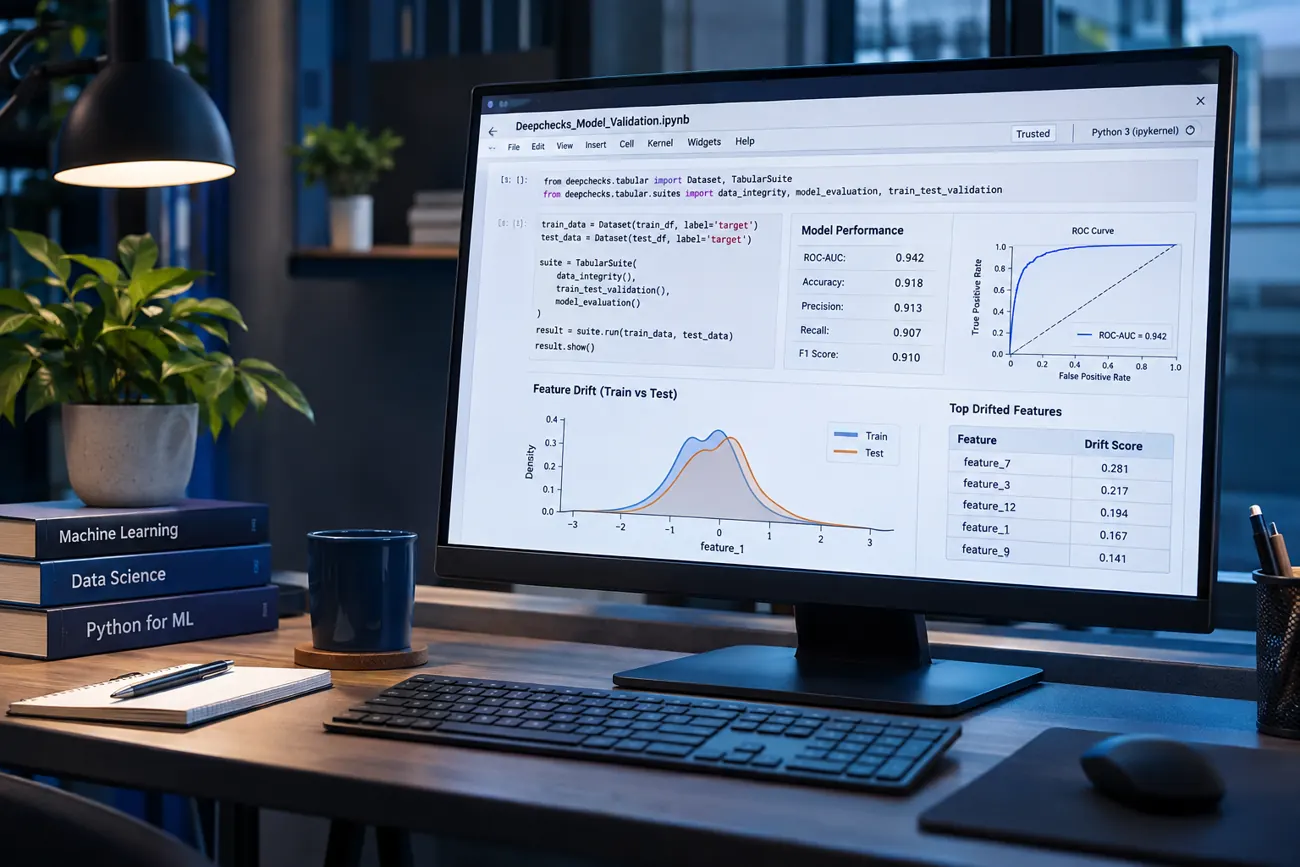
Deepchecks is a validation and testing platform for machine learning and generative AI systems. It helps teams make sure their AI is accurate, reliable, fair and ready for production by testing data and models at every stage of the lifecycle.
The core is an open-source Python package with ready-made checks and suites for tabular, NLP and computer vision data, while related products add CI collaboration, production monitoring and LLM evaluation.
Everything you need to validate models and data before and after deployment.
Data integrity, train-test and model evaluation suites in one package.
Score generative AI apps for quality, grounding and safety.
Track feature, label and prediction drift over time.
Find weak segments where results fall behind the average.
Interactive notebook displays and shareable HTML reports.
AGPL-3.0 Python library you can customize and extend.
A simple, end-to-end workflow to test, validate and keep your AI systems reliable in production.
Load your data, models and LLM outputs into Deepchecks objects.
Run automated checks and suites with pass or fail conditions.
Read clear results, insights and root causes in reports.
Keep watching performance and data quality in production.
Tools to test, evaluate and continuously monitor models and data, so teams can ship high-quality, responsible AI.
Deepchecks gives AI teams one consistent set of checks for every stage. The same logic that validates a dataset in a notebook can gate a CI build and later watch the deployed model, which keeps quality standards aligned from research to production.
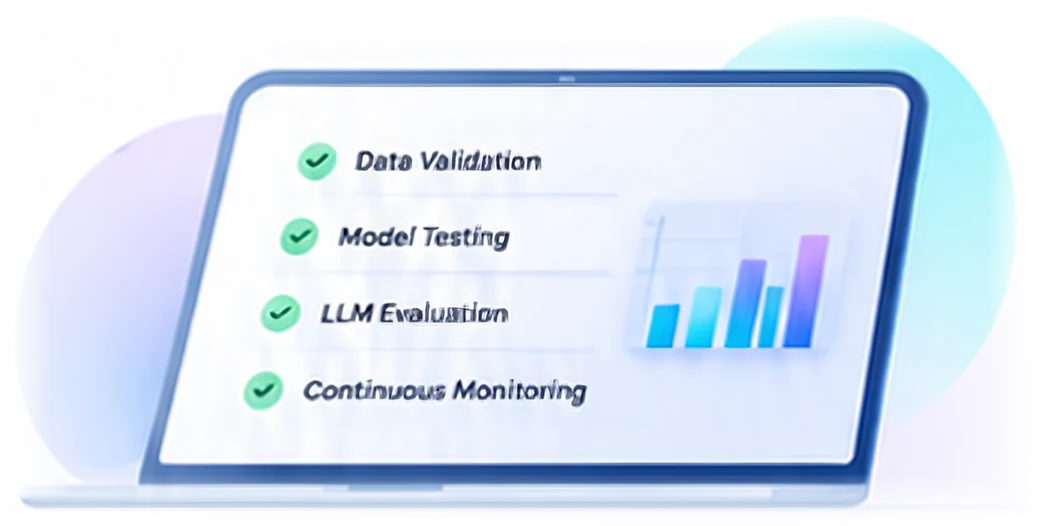
Validation for classic machine learning, evaluation for LLM applications and monitoring once models go live.
Ensure your models are built on high-quality data and perform reliably. Run data checks, model tests and robustness evaluations before and after deployment.
Learn More
Systematically evaluate and test LLMs for quality, factuality, safety and reliability. Use built-in and custom checks to align your models with real-world requirements.
Learn More
Keep your AI healthy in production with ongoing checks for data drift, performance changes and emerging risks. Get timely alerts and clear insights, so you can act fast.
Learn More
Get the open-source source code from GitHub or install the package straight from PyPI.
A flexible open-source library for testing, validating and monitoring ML models and data in Python. Use it in notebooks, CI/CD or your own workflows.
pip install deepchecks -U --userGet the code from the Deepchecks GitHub repository, PyPI or conda-forge only.
Install inside a virtual environment to avoid dependency conflicts.
Version details are published on GitHub releases and PyPI; review them before upgrading.
A production-ready approach for teams that take AI quality and reliability seriously.
Catch issues early and ship models with confidence.
Managed and self-hosted options built for real-world use.
Use the platform or the open-source library, your way.
Evaluate fairness, safety and reliability with evidence.
For any team that builds, deploys or manages AI systems.
Build higher-quality, more reliable models before release.
Ensure data quality and catch integrity issues early.
Monitor, maintain and keep models healthy in production.
Reduce risk and deliver responsible AI at scale.
Three short steps take you from installation to your first validation report.
Run pip install deepchecks -U --user, or add extras such as deepchecks[nlp] and deepchecks[vision].
Create Dataset objects with your label column and categorical features.
Run a built-in suite, view results with result.show() or save them as HTML.
A balanced look at strengths and limitations before you adopt it.
Quick answers for the setup problems users run into most often.
Upgrade pip, use a clean virtual environment and run python -m pip install deepchecks so pip matches your interpreter.
Your Jupyter kernel likely points to another environment. Install into that kernel's environment or switch kernels.
Create a fresh environment, install Deepchecks first, then add other libraries and pin working versions.
Match the documentation version to your installed release, since names can change between versions.
Start testing, validating and monitoring your models and LLMs with Deepchecks today.
Quick answers about Deepchecks, its capabilities and how to get started.
Deepchecks is used to test and validate machine learning models and data. It runs checks for data integrity, train-test drift and model performance, and related products extend that work to production monitoring and LLM evaluation.
Yes. The Deepchecks testing package and the monitoring project are open source under the AGPL-3.0 license, with one enterprise directory in the monitoring repository covered by a commercial license.
The testing package includes modules for tabular data, natural language processing and computer vision, each with its own checks and suites.
A check tests one potential problem, such as feature drift. A suite runs an ordered list of checks together, optionally with conditions, and produces one combined report.
Conditions turn a check result into pass, warning or fail outcomes based on thresholds you choose, which makes checks usable as automated tests in pipelines.
Yes. Drift checks compare a reference dataset with newer data and score distribution changes for features, labels and predictions.
Deepchecks offers an LLM evaluation product for scoring generative AI applications on quality, grounding and safety, documented separately from the open-source testing library.
Validation suites can run in CI before deployment, and Deepchecks Monitoring tracks deployed models over time with dashboards and alerts.
Training libraries build models, while Deepchecks focuses on testing them: it inspects data and model behavior with ready-made checks instead of training anything itself.
Deepchecks was founded in 2019 by Philip Tannor (CEO) and Shir Chorev (CTO).
Run pip install Deepchecks -U --user in your terminal, or use conda install -c conda-forge Deepchecks in a conda environment.
Install the optional extras with pip install "Deepchecks[nlp]" or pip install "Deepchecks[vision]". Quotes help shells such as zsh read the brackets correctly.
The source code is on GitHub at github.com/deepchecks/deepchecks. You can clone it with git clone https://github.com/deepchecks/deepchecks.git.
Yes. Results render as interactive displays inside notebooks with result.show(), and they can also be saved as HTML reports.
Yes. Suites run from plain Python scripts, scheduled jobs and CI pipelines, and results can be processed in code or exported.
No. Data integrity and many drift checks work with datasets alone. Supplying a model adds performance, segment and prediction checks.
Call result.save_as_html("report.html") on a check or suite result to create a shareable HTML file.
The open-source monitoring system can be self-hosted. Managed and enterprise options are available for teams that need additional collaboration and security features.
The package is usually installed in a different interpreter than the notebook kernel. Install it with python -m pip inside the kernel's environment or select the correct kernel.
The official documentation is available at docs.deepchecks.com, with quickstarts, a checks gallery and a full API reference.